

 Posts
Posts


This is an English translation of a story by Yuri Sosa that appeared in the Oaxaca newspaper Las Noticias on November 29, 2016. It personalizes the impact of the illegal attempt by the State Government, apparently at the urging of the Church, to evict the Home for the Protection of Young Women of Oaxaca from the building it has occupied for more than 40 years:
For Marcela Santiago Antonio, the Home for the Protection of Young Women of Oaxaca (a Civil Association) means a better future.
The young woman, from San Pedro Jicayan, on Oaxaca's coast, came to the City of Oaxaca, the State capital, at the age of 18, with the goal of studying towards a professional career. Thanks to the support that this organization provided, she has achieved her goal and is now a college graduate with a license in Intercultural Education.
"The only thing I ask is that they don't throw us out of this space; for some of us it's the only way we have to go forward," pleads Ms. Santiago Antonio, a few hours after the Monday pre-dawn raid by elements of the State Police with the intent of evicting the residents and staff of the shelter, located in the Historic Center of Oaxaca.
Since the young women still do not know how this attempt to evict them will end, they remain barricaded in the building.
Through a window beyond which can be seen one of the young women's rooms, Marcela caled for the authorities to allow the center to remain open.
If she had remained in her village, she would have had to end her studies after high school, the highest level of education available there. But one day the village doctor, who had come from the Capital, told her about the Home for the Protection of Young Women in Oaxaca, where she could stay while attending the university, she explained, surrounded by her companions.
"This is a safe place, where you meet other people with the same goal, which is to better ourselves," she said. "Here we're not alone; we're part of a group."
Marcela said that one of the goals the young women share is to spread the word about the existence of the shelter in the communities they come from, so that other young women can have the same chance to better themselves.
She is eternally grateful to the director and staff of the Home since she, at the age of 26, can still live there and be provided with the necessities of life.
"If the Home were to close, I don't know what I would do, where I could go," she said. "The doctor who helped me died six years ago." As she spoke, her companions indicated with their expressions that they would be in the same desperate situation.
-----
You can read more about these events at the following URLs:
http://viva-oaxaca.blogspot.mx/2016/11/chronicle-of-illegal-and-failed.html
http://viva-oaxaca.blogspot.mx/2016/11/cronica-de-un-desalojo-ilegal-y-fallido.html
http://viva-oaxaca.blogspot.mx/2016/11/church-and-state-vs-vulnerable-young.html
Saturday, December 3, 2016


Wednesday, November 30, 2016
CHRONICLE OF AN ILLEGAL AND FAILED EVICTION IN OAXACA--CHURCH AND STATE VS POOR AND INDIGENOUS YOUNG WOMEN
Chronicle of an illegal and failed
eviction
First
communication
In the pre-dawn
hours of the 28th of November, three days after the
commemoration of the International Day for the Elimination of
Violence against Women, and three days before the end of the term of
the governor of the the State of Oaxaca, approximately 40 members of
the State Police under the direction of Commander Vicente Cruz Morga
arrived at the Home for the Protection of Young Women of Oaxaca,
located at the corner of Matamoros and Tinoco y Palacios in the
city's historic center. Their intention was to intimidate the young
women living there so that the police could enter and take possession
of the building illegally. Since the police did not possess an
eviction notice, the young women asked the police to wait until the
person responsible for the building could arrive, and denied them
entrance.
When Luz de la
Rosa, Director of the Protection of Young Women of Oaxaca program,
arrived, Commander Morga did not produce a document or order for
eviction, and said that they would wait for the person in charge of
the eviction, who would present the document so that they could
proceed. Some time later a person arrived who did not want to
identify himself in an official manner, but who said he was Angel
Donato, who ,we found out later, is the current legal officer of the
Secretariat of Administration of the State Government, by the name of
Angel Donato Ramirez Cabrera. He demanded in a domineering manner
that the door be opened so that the eviction from the building could
proceed. When he was asked to produce a legal document to support his
demand, he argued that he was the authority and that he did not need
to produce any document.
After we refused
to open the door, he gave orders to the police to knock down the
door. At the same time, all of the police officers who had come in
the Kodiak riot-squad truck and two patrol cars got down to follow
his order. We asked for intervention from the Human Rights Defense
agency and from the Special Office for Attention to Crimes Against
Women, so that they could observe and testify about the proceedings.
Nonetheless, we were told that everything would be done according to
the law (although he never produced any official document), and that
everything would be recorded on video. Angel Donato asked by
telephone for a locksmith to force entrance, who arrived almost
immediately. We asked the locksmith who had sent him, and he said he
was sent by Father Alejandro (Rodriguez Gonzalez). From that we
understood that the situation was not only on the part of the state
government but also under the auspices of the clergy of Oaxaca.
Because we would
not let them get close to the main door to the building, Donato gave
the order to force the lock on the door of the small grocery store
that is part of a project to help sustain the Casa. The locksmith,
surrounded by ten police officers, tried to force the lock. After he
was unable to open the lock with his tools, they tried to knock the
door down with blows. Fortunately, they were not able to achieve
their goal, since the young women inside the Home had put a large
quantity of furniture against the door to impede the illegal, forced
entry by the police force.
Given the
determination of the State Police and the legal officer of the
Secretariat of Administration, we started a series of video
recordings to publish on social networks the outrage that was
victimizing the young women of our organization, which provides them
the only means of continuing their studies. In this way, the civil
society would solidify in our support. After not being able to
achieve their illegal entry, the police decided to leave, although
not without threatening that they would return with more force and
with the necessary documents, saying, “We can go in and we will go
in.”
After this, we
began to take precautionary legal steps on behalf of the young women
of our organization to guarantee their security and their physical,
psychological and moral safety.
We appeal to the
State Authorities (secular) and to the Church for them to conduct
themselves legally, in the same manner that we have done, and not to
fall into the temptation to traffic in influence-peddling.
Pedro Lemus
Volunteer for the
Home for the Protection of Young Women of Oaxaca
Spanish-English translation by Robert Adler
You can find the Spanish original here.
Tuesday, November 29, 2016
Crónica de un desalojo ilegal y fallido--Chronicle of an illegal and failed eviction
1er comunicado
La madrugada del 28 de
noviembre, tres días después de conmemorar el día Internacional de
la Eliminación de la Violencia contra la Mujer y tres días antes
del cambio del titular del gobierno del Estado de Oaxaca,
aproximadamente 40 elementos de la Policía Estatal bajo el mando del
comandante Vicencio Cruz Morga llegaron a la Casa de Protección a la
Joven de Oaxaca, ubicada en la calle de Matamoros y Tinoco y Palacios
del centro histórico de esta ciudad. La intención era atemorizar a
las jóvenes que viven ahí para que ellos pudieran ingresar y tomar
posesión del inmueble de manera ilegal. Como no traían orden de
desalojo, se les pidió que esperaran a que llegara la responsable de
inmueble y se les negó la entrada.
En cuanto llegó Luz de
la Rosa, directora de Protección a la Joven, el comandante Morga no
exhibió oficio ni orden de desalojo, por lo cual dijo que esperarían
a la persona que estaba a cargo de este desalojo, quien presentaría
el mencionado documento y así proceder. Tiempo después, arribó una
persona que no quiso identificarse de manera oficial, quien dijo
llamarse Ángel Donato, del quien nos enteramos después, es el
actual encargado jurídico de la Secretaría de Administración del
Gobierno del Estado, de nombre Ángel Donato Ramírez Cabrera. Él
solicitó de manera prepotente que se abriera la puerta para hacer el
desalojo del inmueble; cuando se le pidió que mostrara la
documentación legal en la que se fundaba su solicitud, argumentó
que él era la autoridad y que no tenía por qué mostrar ningún
documento.
Ante nuestra negativa de
abrir, él dio órdenes a la policía para acercarse a la puerta y
derribarla. En ese momento todos los elementos de la policía que
venían en el camión Kodiac de granaderos y las dos patrullas se
bajaron de los vehículos para cumplir la orden. Solicitamos la
intervención de la Defensoría de los Derechos Humanos y de la
Fiscalía Especializada para la atención de Delitos contra la Mujer
a fin de que dieran testimonio y acompañaran el procedimiento, sin
embargo ellos dijeron que todo se iba a dar conforme a derecho
(aunque no exhibió ningún documento oficial) y que se iba a grabar
todo en video. Ángel Donato solicitó vía telefónica la llegada de
un cerrajero para forzar la entrada, el cual llegó casi de manera
inmediata, le preguntamos quién lo estaba enviando y él cerrajero
mencionó que lo enviaba el Padre Alejandro (Rodríguez González).
Así que la situación ya no sólo era de parte del Gobierno del
Estado sino también de la cúpula del clero de Oaxaca.
Como no permitimos que se
acercaran a la puerta principal, Donato dio la orden para que
forzaran la cerradura de la puerta de una tienda de abarrotes que
forma parte de un proyecto productivo con el que se ayuda al
sostenimiento de la Casa. El cerrajero, custodiado por una decena de
policías, intentó forzar la cerradura; al no poder abrir con sus
herramientas, intentaron derribar a golpes la puerta.
Afortunadamente no pudieron lograr su cometido, aunque las jóvenes,
desde adentro ya habían puesto en las puertas cualquier cantidad de
muebles a modo de impedir el ingreso ilegal de la fuerza pública.
Ante el empecinamiento
del personal de la policía estatal y del encargado jurídico de la
Secretaría de Administración, iniciamos una serie de grabaciones en
video para publicar en redes sociales el atropello del que estaban
siendo víctimas las jóvenes de esta organización, quienes han
encontrado en este proyecto la única forma de continuar sus
estudios. De esta manera la sociedad civil se solidarizó para apoyar
y después de no lograr el ingreso ilegal, optaron por retirarse, no
sin antes advertir que regresarían con más elementos y con la
documentación requerida: “por que de que entramos…, entramos”.
Después de esto, se
iniciaron los procedimientos legales correspondientes a fin de
obtener medidas cautelares para las jóvenes de esta organización,
así como garantizar su seguridad, su integridad física, sicológica
y moral.
Apelamos a que las
autoridades del Estado (laico) y de la Iglesia se conduzcan por la
vía legal de la misma manera en que nosotros lo hemos hecho y no
caigan en la tentación de traficar con influencias.
Pedro Lemus
Colaborador voluntario de
Casa de la Protección a la Joven
Puede leer mas noticias de este asunto, en ingles, a este URL.
Puede leer mas noticias de este asunto, en ingles, a este URL.
CHURCH AND STATE VS VULNERABLE YOUNG WOMEN IN OAXACA
Oaxaca's Casa de la Proteccion a la Joven (Home for the Protection of Young Women), in the historic center of the city, has sheltered, protected, and educated vulnerable young women since 1974. It's a highly successful program, run on a shoestring, that provides a home, community, counseling and other assistance to up to 20 girls and young women who have come to Oaxaca from indigenous communities and outlying villages to try to create better lives for themselves.
At 4:00 a.m. on November 28, without warning, the home was assaulted by approximately 40 members of Oaxaca's State Police along with a representative of the State Secretariat of Administration. They attempted to evict the 20 young women asleep in the shelter, along with Luz Maria de la Rosa Hernandez, the program's director. Remarkably, the women were able to barricade the heavy wooden door to the home, and, so far, prevent the eviction.

According to the director, neither the police nor the government functionary presented any kind of legal documentation or justification for the raid.
The director explains that, for the last few years, the Archdiocese of Oaxaca has been trying to appropriate the building that has been the program's home for more than forty years. As is often the case in Oaxaca, the building's ownership history is unclear, and the Church's claim to the property was in the process of being negotiated and litigated.
However, it appears that rather than allowing the legal process to take place, the Archdiocese prevailed on the outgoing state government (the six-year term of the current governor, Gabino Cue Monteagudo, ends tomorrow, November 30) to order the State Police to evict the women and take possession of the property.
Ms. de la Rosa explains that the program has been housed in the same building since 1972, through a series of 15-year concords with the State. It appears that the original owner, General Francisco Leon, stipulated that on his death the building should be used for the public good, by an academy that no longer exists. At some point the State apparently appropriated the building, and, until recently, was content for it to house the program for the protection of young women.
Why the State changed its mind is not clear, but, as reported in the newspaper Las Noticias on 29 November, it may have decided to give the building to the Arcdiosese in compensation for a building "erroneously" appropriated from the Church in a neighboring city by the previous governor, Ulises Ruiz Ortiz. The Archdiocese claims that the property was granted to two local priests for their private use.
From behind the barricaded doors of the Home for the Protection of Young Women, Ms. de la Rosa said that she had requested the intervention of the Defensoria de los Derechos Humanos del Pueblo de Oaxaca (Defenders of Human Rights of the People of Oaxaca) to prevent further violation of the rights of the young women in the program.
Explaining that this apparent misuse of the power of the Church and State could not succeed once it became public knowledge, Ms. de la Rosa asked for help in spreading word of the attempted eviction as widely as possible.
"This home is the only one many of us have," said one of the young women in the program.
"All we ask is that they don't throw us out of this space," said another. "It's the only way we have to move ahead."
A detailed account (in Spanish) of the attempted eviction appears along with this report.
At 4:00 a.m. on November 28, without warning, the home was assaulted by approximately 40 members of Oaxaca's State Police along with a representative of the State Secretariat of Administration. They attempted to evict the 20 young women asleep in the shelter, along with Luz Maria de la Rosa Hernandez, the program's director. Remarkably, the women were able to barricade the heavy wooden door to the home, and, so far, prevent the eviction.

Some of the staff and young women of La Casa para la Proteccion de la Joven
in the building's courtyard. Director Luz de la Rosa (front row, center)
According to the director, neither the police nor the government functionary presented any kind of legal documentation or justification for the raid.
The director explains that, for the last few years, the Archdiocese of Oaxaca has been trying to appropriate the building that has been the program's home for more than forty years. As is often the case in Oaxaca, the building's ownership history is unclear, and the Church's claim to the property was in the process of being negotiated and litigated.
However, it appears that rather than allowing the legal process to take place, the Archdiocese prevailed on the outgoing state government (the six-year term of the current governor, Gabino Cue Monteagudo, ends tomorrow, November 30) to order the State Police to evict the women and take possession of the property.
Ms. de la Rosa explains that the program has been housed in the same building since 1972, through a series of 15-year concords with the State. It appears that the original owner, General Francisco Leon, stipulated that on his death the building should be used for the public good, by an academy that no longer exists. At some point the State apparently appropriated the building, and, until recently, was content for it to house the program for the protection of young women.
Why the State changed its mind is not clear, but, as reported in the newspaper Las Noticias on 29 November, it may have decided to give the building to the Arcdiosese in compensation for a building "erroneously" appropriated from the Church in a neighboring city by the previous governor, Ulises Ruiz Ortiz. The Archdiocese claims that the property was granted to two local priests for their private use.
From behind the barricaded doors of the Home for the Protection of Young Women, Ms. de la Rosa said that she had requested the intervention of the Defensoria de los Derechos Humanos del Pueblo de Oaxaca (Defenders of Human Rights of the People of Oaxaca) to prevent further violation of the rights of the young women in the program.
Explaining that this apparent misuse of the power of the Church and State could not succeed once it became public knowledge, Ms. de la Rosa asked for help in spreading word of the attempted eviction as widely as possible.
"This home is the only one many of us have," said one of the young women in the program.
"All we ask is that they don't throw us out of this space," said another. "It's the only way we have to move ahead."
A detailed account (in Spanish) of the attempted eviction appears along with this report.
Sunday, October 30, 2016
New Day of the Dead photos from Oaxaca
El Dia de los Muertos, or Day of the Dead, is in full swing in Oaxaca. Here are a few glimpses of this modern festival with ancient roots. It's essence, welcoming, nurturing and communing with the faithful dead on their once-a-year return:

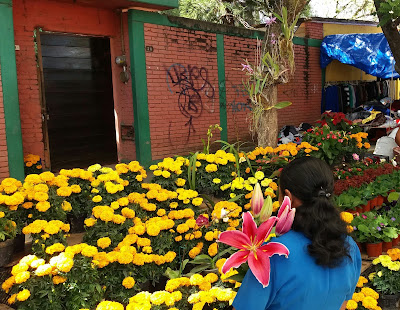


Muertos ready for the fiesta

A woman selects flowers for her altar

A Catrina dressed to kill

Pan de Muertos--Bread for Day of the Dead

An altar at the childhood home of Lila Downs

Detail of the altar
 Flower vendor's baby at Sanchez Pascua market

Monday, February 15, 2016
Touring Monte Alban--Monte Alban factsheet
Monte Alban, a UNESCO World Heritage site, contains the partially excavated and reconstructed ruins of the religious-administrative center of the ancient Zapotec dominion. The ruins rest on an artificially flattened mountaintop about 6 miles west of Oaxaca City, overlooking the three arms of the region's Central Valley.
 |
One of Monte Alban's monumental structuresThe site is of great archaeological and cultural interest; it was the first urban center in Mesoamerica—the geographic-cultural area extending from central Mexico to northern Costa Rica--and was the center of the prehispanic Zapotec civilization for almost 1300 years. The Zapotecs developed one of the earliest forms of writing in the Americas, as well as a sophisticated counting system and a complex, astronomically-based calendar. Many of the people you'll see in the city of Oaxaca and nearby towns are the descendants of the builders and citizens of Monte Alban. |

Visitors
please note: The site is 6,400
feet above sea level, and just 17 ͦ
north of the equator, so the sun can be very strong. Please use
sunscreen and bring water and a hat. You can buy tickets and
enter and explore the site on your own, or you can hire one of the certified guides at the site. They may or may not give you the most up-to-date archaeological information, but you will almost certainly learn some interesting things from them. The visitors' center provides restrooms, a cafe, and
a small museum. The museum at the visitors' center is worthwhile, so save some time for
it either before or after you tour the site itself.
We recommend walking clockwise around the Main Plaza. Follow the path from the visitors' center, enter the Main Plaza near its northeast corner, and explore the east, south, west and north sides in that order. If you're motivated, you can climb the South Platform to get a stunning view of the site, or wander around the extensive North Platform, which also features great views.
While you're touring the site, you may be approached by vendors selling reproductions of ceremonial figures discovered at the site. There's nothing wrong with buying some of these if you're so moved. Feel free to bargain, but don't believe it if you're told that these are original pre-hispanic pieces unearthed by the vendors.
We recommend walking clockwise around the Main Plaza. Follow the path from the visitors' center, enter the Main Plaza near its northeast corner, and explore the east, south, west and north sides in that order. If you're motivated, you can climb the South Platform to get a stunning view of the site, or wander around the extensive North Platform, which also features great views.
While you're touring the site, you may be approached by vendors selling reproductions of ceremonial figures discovered at the site. There's nothing wrong with buying some of these if you're so moved. Feel free to bargain, but don't believe it if you're told that these are original pre-hispanic pieces unearthed by the vendors.
Timeline: Monte Alban's earliest structures date from around 500 BC. It enjoyed its political peak from approximately 500 to 750 AD. Its influence began to decline around 750 AD, and it was largely abandoned by 800 AD. In the absence of Monte Alban's dominating influence, a number of smaller city-states jockeyed for power. None of them occupied the site, but they appear to have viewed it as sacred, and used it as for elite burials. Some of the treasures from that period can be found in Room 3 of the Museum of Oaxacan Cultures, next to Santo Domingo church in Oaxaca -- also well worth a visit.
To
put this era in context, the Olmec civilization, thought to be the
earliest in Mesoamerica, thrived between about 1500 BC and 400 BC.
The Maya civilization flourished between approximately 250 AD and 900
AD, while the Aztec Empire rose and fell much later; founded in 1428
AD and conquered by the Spanish less than a century later, in 1521. As another reference point, the period during which Monte Alban dominated the region
was roughly contemporary with ancient Rome (~ 500 BC to ~500 AD).
Although
the site of Monte Alban was known to the Spanish conquistadores
and
described by visitors and a few archaeologists through the years, the
first serious excavations and reconstructions did not take place
until 1931, under the direction of Mexican archaeologist Alfonso
Caso. You'll see a high-relief sculpture of Caso, looking a bit like
the frozen Han Solo in Star Wars, as you enter the site.
Estimated Population: Although Oaxaca's central valleys have been occupied since at least 8000 BC, Monte Alban itself does not seem to have been inhabited prior to its founding. The city and its surroundings are estimated to have had a population of around 5000 by 300 BC, 17,000 by 100 BC, and 25,000 by 700 AD. Its rulers presided over some 700 square miles of Oaxaca's central valleys and highlands, with an estimated population of around 130,000. Archaeologists are continuing to study sites near Monte Alban and throughout the region, detailing patterns of population, farming, trade, political ties, conquests, etc. Only the religious and political elite lived atop Monte Alban; lower-ranking people lived on the slopes of the mountain and in the surrounding valleys.
WHAT YOU'LL SEE:
The Main Plaza, roughly 330 by 200 yards, occupies the artificially leveled mountaintop. It's surrounded by pyramid-shaped platforms that supported temples and other structures. The platforms were built in successive layers over many hundreds of years. When the site was at its peak, the plaza would have been paved, served by an efficient drainage system, and the pyramids covered with stucco and painted. It was certainly used for religious ceremonies, and may also have served as a marketplace.

View of Monte Alban's Main Plaza from the North Platform
The
Ball Court is a sunken,
I-shaped structure where ritual ball games were held. There's a
second, smaller ball court a few hundred yards east of the visitors'
center. Similar games took place throughout Mesoamerica for over 3000
years, and are thought to have been sacred rather than secular,
reflecting the “cosmovision” of these cultures--their beliefs
about their relationships with the earth, sky, underworld and gods.
The game was played with a heavy rubber ball that was kept moving by
bouncing it off parts of the body other than the feet or hands,
especially the hips. Games may well have been associated with human
sacrifices, which were seen as vital to nurturing the gods and ensuring order.
The
Palace, the second building
south of Building P (discussed
below), is a dwelling
of the Zapotec nobility. A massive staircase leads to a private court
surrounded by rooms, plus a shrine in the center.
Building
J stands out because it is
arrow-shaped and oriented roughly 45 degrees from the other
structures. It's one of just two such buildings in all of ancient
Mesoamerica, the other located at Caballito Blanco, about 30 miles to
the east. Building J occupies the center of the south end of the main
plaza. You can get the best view and sense of its shape if you climb
(carefully!) the South Platform.


Monte Alban's arrowhead-shaped Building J
Building
J was started around 250 BC and, like many buildings throughout
ancient Mesoamerica, had levels added on, like successive layers of
an onion. We know that it commemorated victories over surrounding
cities, recorded on “conquest slabs” visible along the building's
walls (and in the museum). Each slab shows a pyramid—the symbol for
a city—along with identifying information, a date, and in some
cases an inverted head, perhaps indicating a military victory rather
than a political assimilation.
Building
J is also thought to have served as an astronomical observatory,
probably supporting the complex Monte Alban calendar based on a 260
day ceremonial cycle (20 named days times 13 numbered days), a
365 day solar cycle, and a 584 day Venus cycle. The
ceremonial and solar cycles coincide every 52 years, and all three
cycles coincide every 104 years. There's some rather complicated
astronomical evidence that has led distinguished local archaeologist
Marcus Winter and colleagues to argue that this calendar was first developed
at Monte Alban and
eventually spread throughout ancient Mesoamerica.
Throughout Mesoamerica, all religious, political and agricultural events were organized around the calendar. In addition, astronomical and calendrical relationships were incorporated into the architecture. For example, the ratio of the lengths of Monte Alban's two ballcourts is 365:260, while the ratio of the widths of the North Platform's main staircases are 365:584.
Throughout Mesoamerica, all religious, political and agricultural events were organized around the calendar. In addition, astronomical and calendrical relationships were incorporated into the architecture. For example, the ratio of the lengths of Monte Alban's two ballcourts is 365:260, while the ratio of the widths of the North Platform's main staircases are 365:584.
Building
J exhibits some remarkable archeoastronomical features. The arrowhead points toward the point on the horizon where the sun sets on the two days of the
year when it passes directly overhead at noon--called the zenith
passage--May 8 and August 5. In addition, a sight-line from the
arrowhead through a doorway at the opposite side of the building
points directly to a vertical shaft in the center of Building P,
on the east side of the plaza. That shaft allows a flash of sunlight
to illuminate an otherwise dark interior room at noon on those two
days, where presumably an important ritual took place. An ancient
astronomer-priest awaiting the May zenith passage would have been
tipped off by the first appearance of the bright star Capella over
Building P just before dawn on the crucial day. To add to the drama,
at noon on those same two days the walls forming the arrowhead of Building J are
simultaneously illuminated, highlighting the conquest slabs. The
ritual importance of Building P is emphasized by the elaborate Shrine
directly in front of it.
Just
north of Building J you'll see a complex of buildings G, H and I,
also thought to have been an important site for religious ceremonies.
Los
Danzantes (the dancers) are a
collection of friezes depicting grotesque or distorted human figures.
They date from the earliest years of Monte Alban. You'll find some of
the 300 that have been found along the wall of Building L,
or Palace of the Dancers, near
the southwest corner of the main plaza. The exposed friezes are
copies, but several original ones are visible in a protected
area near the north end of the palace (or temple), and in the
visitors' center.
Although they've been called “dancers” for more than a century because of their striking poses, that's one thing they definitely are not. You're welcome to come up with your own theory about what they are, since archaeologists are still unsure. Various authorities argue that they represent captured and tortured enemies, mythological giant ancestors of the Zapotecs, sacrificial victims or volunteers, shamans, or simply decorations. One intriguing theory is that they are medical case studies, and as such, would be a very early indication of the development and diffusion of medical knowledge by the Zapotecs. If you look closely, you'll see that many of them do seem to show anatomical details, childbirth, etc. It's known that the ancient Zapotecs practiced dental and cranial surgery. You can see some of their work in the on-site museum.
Although they've been called “dancers” for more than a century because of their striking poses, that's one thing they definitely are not. You're welcome to come up with your own theory about what they are, since archaeologists are still unsure. Various authorities argue that they represent captured and tortured enemies, mythological giant ancestors of the Zapotecs, sacrificial victims or volunteers, shamans, or simply decorations. One intriguing theory is that they are medical case studies, and as such, would be a very early indication of the development and diffusion of medical knowledge by the Zapotecs. If you look closely, you'll see that many of them do seem to show anatomical details, childbirth, etc. It's known that the ancient Zapotecs practiced dental and cranial surgery. You can see some of their work in the on-site museum.

Danzante bas-relief, possibly depicting childbirth
System IV
is a compound typical of later
Zapotec constructions. It consists of a square pyramid-shaped
platform that had a temple on top, plus its own small plaza with a
shrine in the center. It's very similar to Compound M, just south of
Los Danzantes. Outside the north side of the System IV stands a
striking stone column, or stele,
with calendar-related glyphs. This may well have been used to track the
position of the sun at key points of the year.

Astronomical or Calendrical Stele at Monte Alban
The North
Platform is a large complex of
structures that occupies the entire north end of the site. You can
see the remains of a temple supported by columns, a large sunken
plaza with a tomb in the center, and the remains of many other
structures and tombs. Some of the tombs have striking multicolored
murals. Unfortunately, they are not open to the public.
Archaeologists tell us that this part of the site reveals intensive
contact with Teotihuacan,
a large and powerful city-state that flourished in the Valley of
Mexico, near modern Mexico City, between about 100 BC and 800 AD.
Archaeologists have also found signs of a significant Zapotec enclave
at Teotihuacan from about 100 BC to 350 AD.
The
on-site museum features
inscribed stone monoliths, or stelae, two of which reveal the
earliest writing in Mesoamaeria, one of just five places in the world
where writing was invented. You'll also see some of the original
conquest stones and “dancers,” pottery, figurines, urns, and a
reproduction of one of the many burials found in tombs throughout the
site. There are also skulls showing deliberate “cosmetic”
deformation and dental modification, and some showing trepanation, or
skull surgery.
In short, when you come to Oaxaca, do not miss Monte Alban!
Robert Adler
Oaxaca, Mexico
Fair use note: This description of Monte Alban is available for free for personal, non-commercial use. It can be downloaded, printed, duplicated or disseminated for that purpose; simply credit Robert Adler.
Robert Adler
Oaxaca, Mexico
Fair use note: This description of Monte Alban is available for free for personal, non-commercial use. It can be downloaded, printed, duplicated or disseminated for that purpose; simply credit Robert Adler.
Tuesday, January 26, 2016
December celebrations in Oaxaca
2015

Little Angels, Noche Buena 2016

from Night of the Radishes, 2016
Oaxaca is at its best in December, with two remarkable celebrations, the Night of the Radishes on the 23rd, and Las Posadas, on the 24th.
You can view a selection of my photos of the Night of the Radishes here.
And from Las Posodas, or Noche Buena at this URL.
Subscribe to:
Posts (Atom)